What is LawSynth?
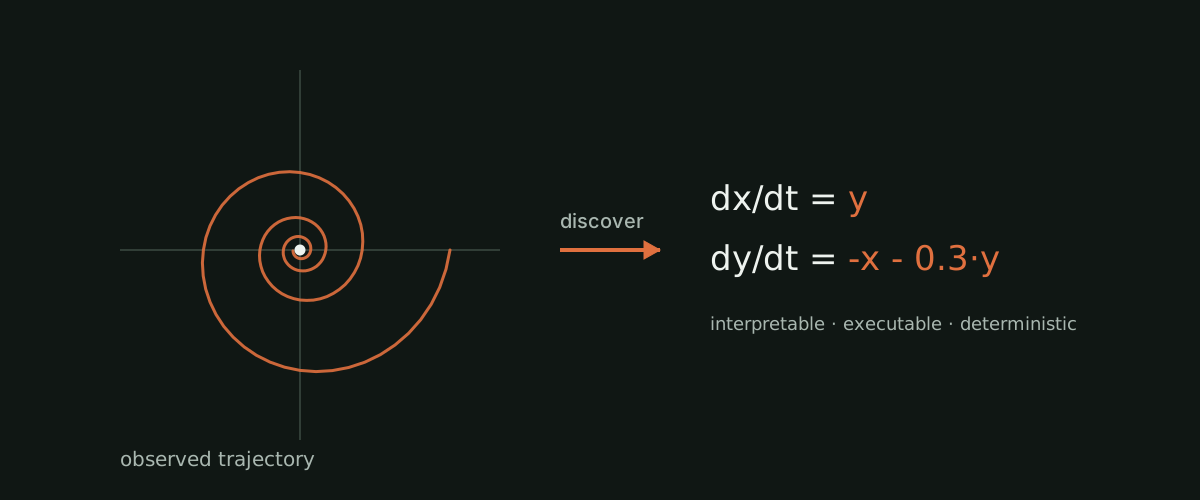
LawSynth discovers interpretable, executable law systems from time-series data. Point it at a CSV and it recovers the governing equations behind the numbers — a world you can read, simulate, analyze, control, and share. If you can't read and reason about the result, it isn't a LawSynth result.
What you get
- Explicit laws, not black boxes. Discovery returns equations like
dx/dt = σ (y − x)with fitted parameters — not opaque weights.
- Deterministic and offline. The same inputs produce a bit-identical world, on any machine, with no network access. Reproducibility is a contract, not a hope.
- One portable artifact. Every discovery is a
.lsworldbundle, and every downstream tool operates on that single file.
The core loop

observe (CSV) → discover (laws) → understand (explain) → use (forecast / analyze / control) → share (report / export / .lsworld)Each step is a real command in the lawsynth CLI, mirrored by the Python and TypeScript SDKs. Discovery is a sparse fit to your data — a compact hypothesis, not proof of causality — and every world records the uncertainty and assumptions behind it.
Local-first and reproducible: the same inputs produce the same world, offline, forever.
Where to go next
- Run the whole loop in five commands: Getting started.
- See everything LawSynth can do: Capabilities.
- Understand the differentiator: Why determinism.
- Reproduce a canonical system: Examples gallery.
- Learn the vocabulary: Core concepts.